
Intel mobile CPUs have achieved up to 95x performance uplift over the past two decades
Intel has consistently pushed the boundaries of processor technology and has delivered some of the best CPUs we’ve ever seen. That level of success doesn’t happen overnight. Leading Linux publication Phoronix tested 15 mobile Intel processors over 18 years to show the evolution of processor performance from the Penryn architecture to the cutting-edge Panther Lake. The results are nothing short of astonishing, with Panther Lake delivering up to 95X higher performance than Penryn in specific workloads.
The Core 2 Duo T9300, launched in 2008, is the oldest chip in Phoronix’s tests and resides inside a Lenovo ThinkPad T61. Nearly 20 years later, it’s remarkable that the laptop still boots up and runs fine, considering that the typical lifespan for a modern laptop is around five years, with the really well-made ones pushing up to 10. Maybe it’s true that they really don’t make them as they used to, or the impressive longevity is a testament to Lenovo’s ThinkPad series, which has earned a reputation for its excellent durability over the years.
It’s fascinating to think that dual-core designs were the standard back then. Over time, configurations expanded to quad-core designs, and recent generations of mobile Intel processors feature up to 16 cores. The leap in core counts benefited significantly from Intel’s shift to a hybrid architecture that combines performance and efficiency cores.
| Processor | Codename | Cores / Threads | Max Turbo Boost (GHz) | Launch Date |
|---|---|---|---|---|
| Core Ultra X7 358H | Panther Lake | 16 / 16 | 4.8 | 2026 |
| Core Ultra 7 256V | Lunar Lake | 8 / 8 | 4.8 | 2024 |
| Core Ultra 7 155H | Meteor Lake | 16 / 22 | 4.8 | 2023 |
| Core i5-1334U | Raptor Lake | 10 / 12 | 4.6 | 2023 |
| Core i7-1280P | Alder Lake | 14 / 20 | 4.8 | 2022 |
| Core i7-1165G7 | Tiger Lake | 4 / 8 | 4.7 | 2022 |
| Core i7-1065G7 | Ice Lake | 4 / 8 | 3.9 | 2019 |
| Core i7-8565U | Whiskey Lake | 4 / 8 | 4.6 | 2018 |
| Core i7-8550U | Kaby Lake | 4 / 8 | 4.0 | 2017 |
| Core i7-5600U | Broadwell | 2 / 4 | 3.2 | 2015 |
| Core i7-4558U | Haswell | 2 / 4 | 3.3 | 2013 |
| Core i7-3517U | Ivy Bridge | 2 / 4 | 3.0 | 2012 |
| Core i5-2520M | Sandy Bridge | 2 / 4 | 3.2 | 2011 |
| Core i7-720QM | Clarksfield | 4 / 8 | 2.8 | 2009 |
| Core 2 Duo T9300 | Penryn | 2 / 2 | 2.5 | 2008 |
Phoronix performed 150 benchmarks on each processor under Ubuntu 26.04. The list of tests included daily workloads, such as web browsing and media coding, as well as more specialized workloads, including database management, AI, and HPC.
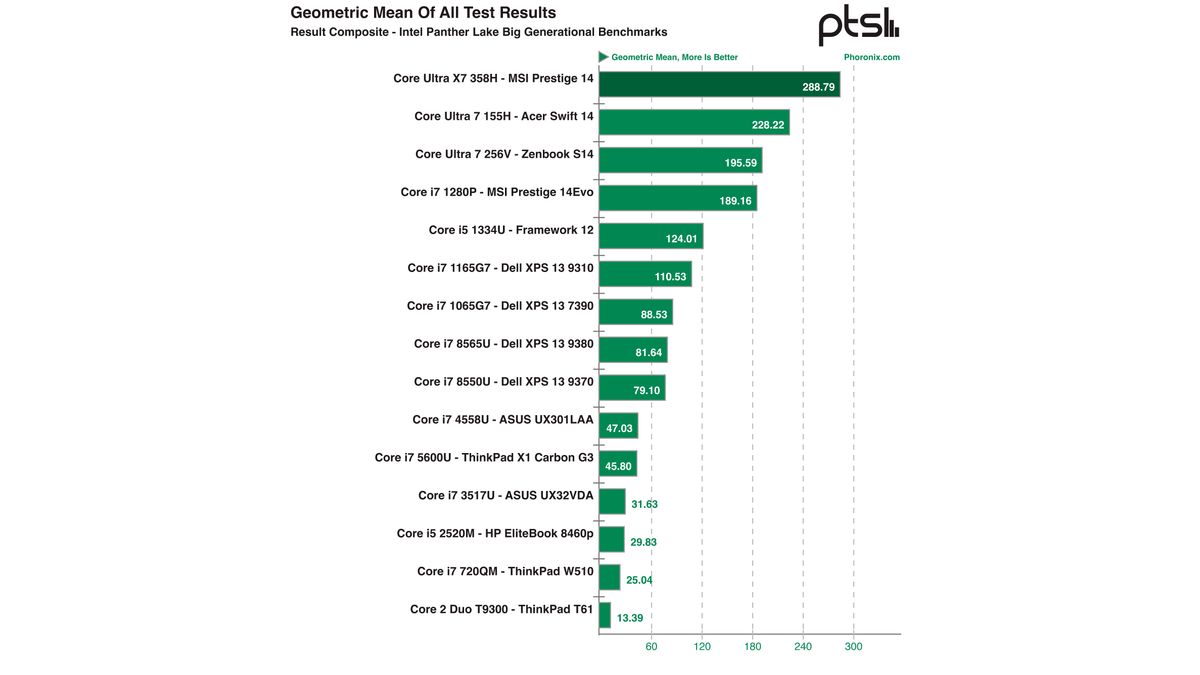
Out of the 150 benchmarks, the Core Ultra X7 358H (codenamed Panther Lake) was up to 95X faster than the Core 2 Duo T9300 (codenamed Penryn) in OpenSSL and 93.9X in OpenVINO AI. New hardware instruction sets, such as AVX-512, and AI-driven workloads favor Panther Lake and the NPU inside after all. The geometric mean of all the benchmark results revealed that the Core Ultra X7 358H outperformed the Core 2 Duo T9300 by 21.5X. In tasks, such as web browsing or photo manipulation, the improvements were up to 10X.
For a somewhat more modern comparison, the Core Ultra X7 358H, on average, was up to 9.7X faster than the Core i5-2520M (codenamed Sandy Bridge). When examining the most significant generation-over-generation improvement, the Core i7-720QM (codenamed Clarksfield) stood out, delivering 1.9X more performance than the Core 2 Duo T9300. The Core i7-720QM features twice as many cores and supports Hyper-Threading technology, so the result wasn’t surprising.
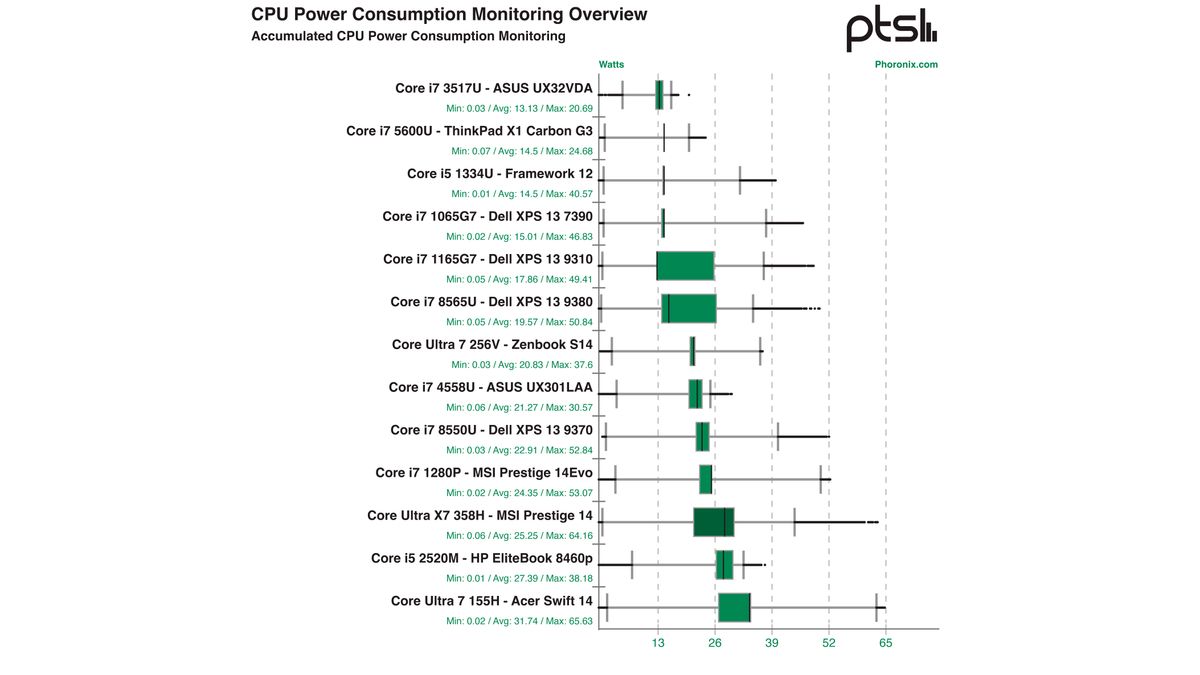
Phoronix noted that both Penryn and Clarksfield lacked support for processor power sensors, preventing the news outlet from collecting power-efficiency data for those processors. Nevertheless, the available information on more recent chips reveals some striking trends in power efficiency.
Panther Lake was not only 9.7X faster than Sandy Bridge but also consumed, on average, 7.8% less power. It’s impressive because the Panther Lake chip comes equipped with 8X more cores compared to the Sandy Ridge part. The Core i7-3517U (codenamed Ivy Bridge) had the lowest average power consumption among the 15 processors. Compared to Ivy Bridge, Panther Lake consumed 1.92X more power but delivered 9.1X more performance.
The quantitative performance gains of Intel mobile chips over the years are impressive. However, Linux’s embrace of older hardware is equally impressive. It’s the reason why the operating system is the de facto choice for users who want to give legacy hardware a second chance at life. It’s unheard of that a 2008-era processor can play nicely with a development version of Ubuntu, much less run a bunch of benchmarks that didn’t exist back then.